Wiggle guide
Hip Mobility for Squats: A Gentle 7-Minute Warm-Up
Hip mobility for squats when depth feels blocked, with a gentle 7-minute squat mobility routine, ankle checks, stop signs, and Wiggle cues.
hip mobility for squats
Squats get frustrating when the problem is not strength. You warm up, drop down, and hit the same hard stop: hips pinch, heels lift, knees cave, or the bottom position feels like a fight instead of a movement.
The fix is not to force a deeper squat. Use a short hip mobility warm-up that tells you what is limiting the position today, then practice the range you can control. Start with the 7-minute routine below before lower-body training, bodyweight squats, or a guided Wiggle session.
What is hip mobility for squats?
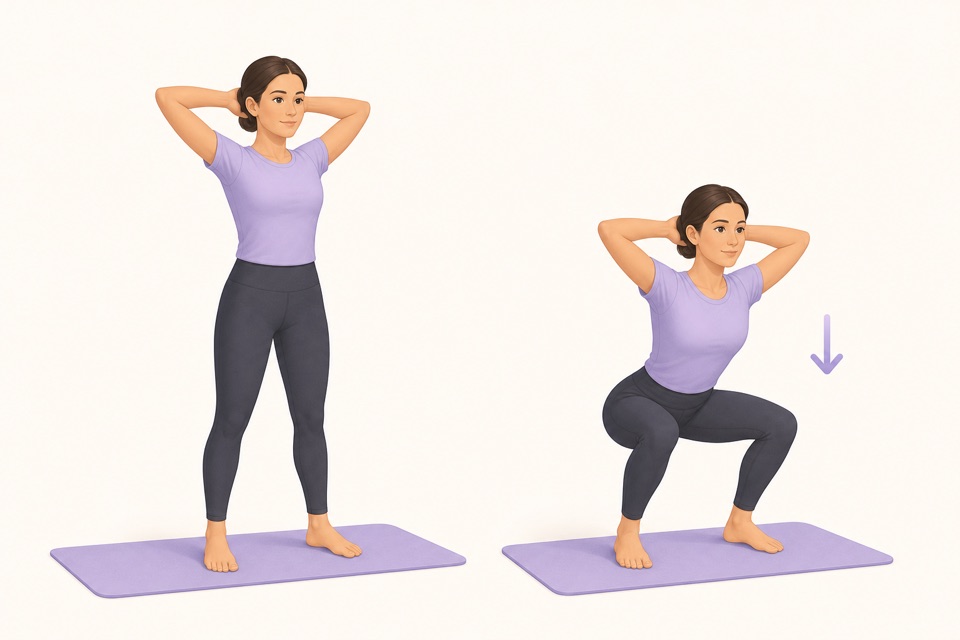
Hip mobility for squats is your ability to bend, rotate, and control the hips enough to sit into a comfortable squat without pinching, collapsing, or compensating through the lower back. It works best when paired with ankle mobility and a squat range you can repeat calmly.
Hip mobility for squats is a practical warm-up skill: hip flexion for depth, hip rotation for knee tracking, adductor range for stance comfort, hip flexor length for posture, and enough control to stand back up without rushing the bottom position.
If you only stretch one area, you may miss the actual limiter. A squat asks the hips, ankles, trunk, and feet to cooperate. Research on squat depth has linked lower-extremity range of motion and strength variables with squat depth, which is why a useful routine checks more than one joint.
What is the best 7-minute squat mobility routine?
The best squat mobility routine starts with easy motion, checks the ankles, opens hip rotation, adds a supported bottom position, and finishes with bodyweight squats. Keep the first round mild. The goal is a better next squat, not maximum stretch intensity.
Use this order:
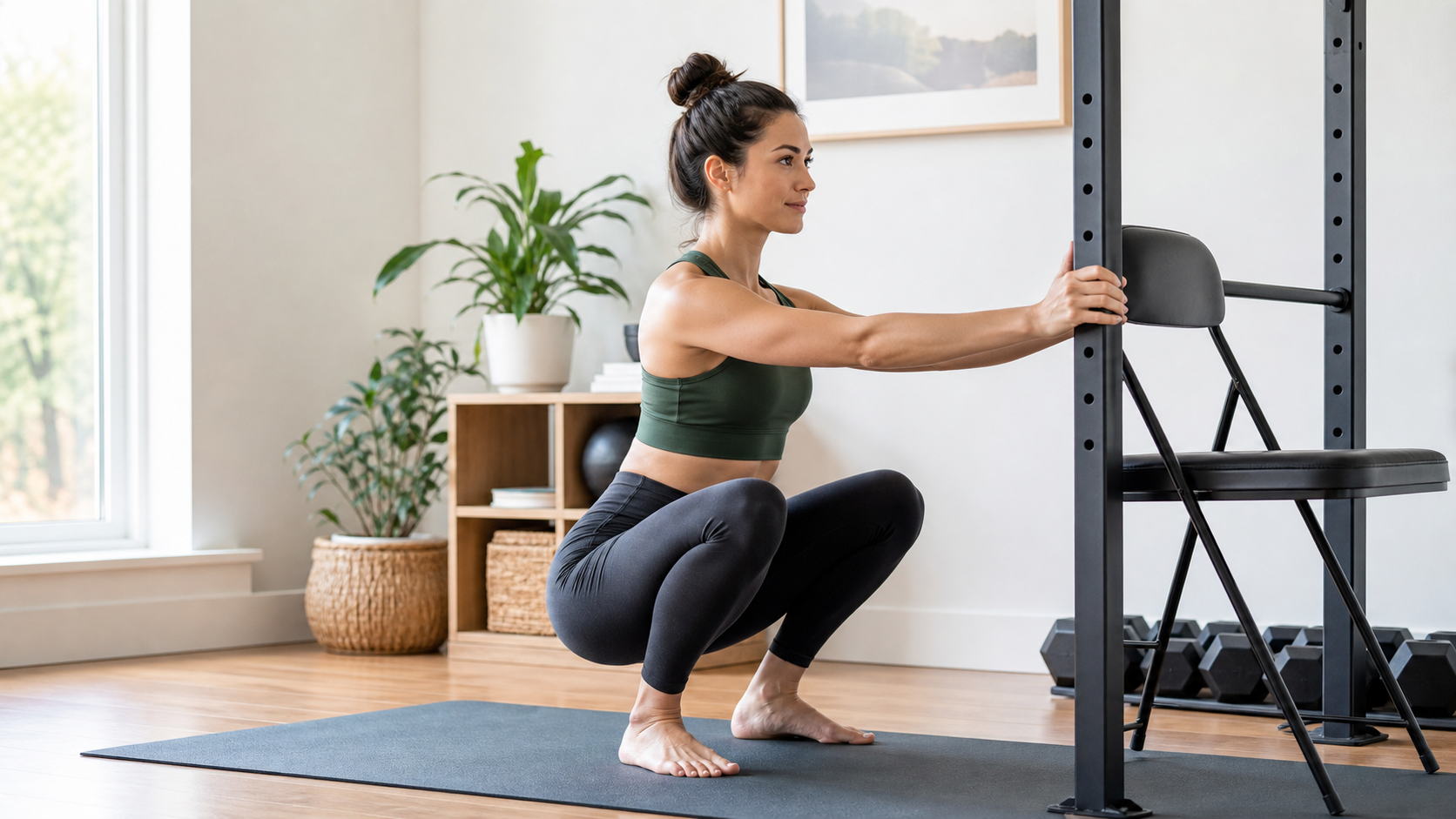
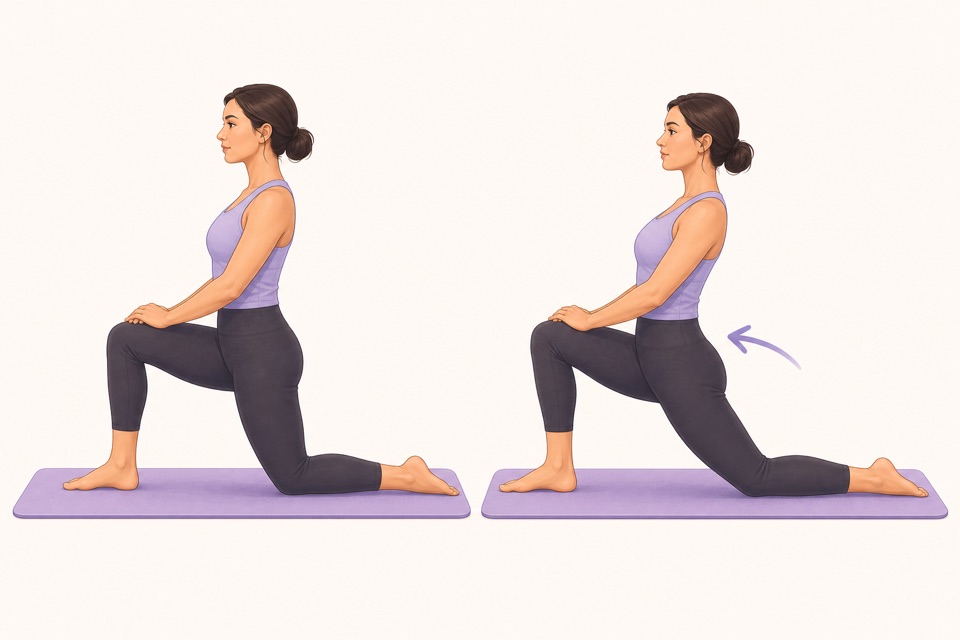
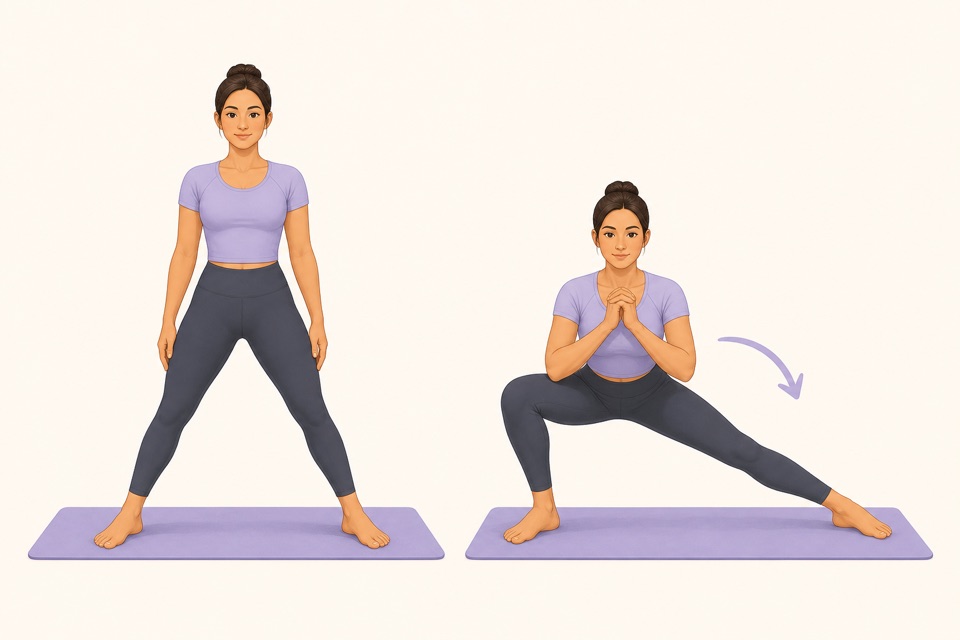
| Move | Time | What it tells you | Make it easier | | --- | ---: | --- | --- | | Easy walk or march | 60 sec | Whether the hips feel better after simple movement | Hold a wall if balance is distracting | | Ankle rocks or circles | 60 sec | Whether heels want to lift early | Use a smaller knee-forward range | | Supported deep-squat hold | 60 sec | Where the squat feels blocked | Hold a door frame, rack, or counter | | 90/90 or seated figure-four | 90 sec | Hip rotation and outer-hip comfort | Sit on a cushion or stay in a chair | | Supported hip flexor stretch | 90 sec | Front-of-hip stiffness | Shorten the stance | | Side-lunge adductor shifts | 90 sec | Inner-thigh and stance comfort | Keep the stance narrow | | Slow bodyweight squats | 60 sec | Whether the warm-up changed the pattern | Squat to a chair or box |
This sequence reduces the decision cost. You do not have to know whether your exact issue is hip flexion, hip external rotation, hip internal rotation, adductor stiffness, or ankle dorsiflexion before starting. You touch each piece gently, then keep the useful parts.
From Wiggle
Recommended moves
Why do hips feel blocked at the bottom of a squat?
Hips often feel blocked at the bottom of a squat because the position combines hip flexion, hip rotation, inner-thigh range, ankle mobility, and trunk control at once. If one piece is not ready, your body may borrow motion from the lower back, knees, or feet.
Use the block as information:
| What you notice | First thing to test | Best next guide | | --- | --- | --- | | Front of hip pinches | Smaller squat depth and hip flexor work | Hip flexor stretches | | Knees cannot open comfortably | Hip external rotation | Hip external rotation stretches | | Back hip feels awkward in 90/90 | Hip internal rotation | Hip internal rotation stretches | | Inner thighs feel like the hard stop | Adductor range | Adductor stretches | | Heels lift early | Ankle rocks and calf work | Calf stretches at desk | | Whole movement feels confusing | Full beginner hip routine | Hip mobility exercises for beginners |
NASM movement-assessment guidance uses squat variations to help separate ankle and movement limitations. A simple version for everyday use: try the squat with your heels slightly elevated. If that makes depth much easier, ankles may be part of the limiter. If the hip still pinches, stay with hip mobility and a smaller range.
Should you stretch hips or ankles first for squats?
Start with one minute of easy movement, then check ankles and hips before deciding. If the heels lift or the torso folds forward immediately, ankle mobility may deserve the first minute. If the hip pinches, knees cave, or stance feels blocked, start with hip mobility.
Use this fast decision rule:
| If your squat does this | Start with | Then add | | --- | --- | --- | | Heels pop up | Ankle rocks | Calf stretch and supported squat | | Knees cave inward | Hip external rotation | Glute or 90/90 work | | Hips pinch in front | Hip flexor stretch in a small range | Box squat or reduced depth | | Inner thighs stop depth | Side-lunge shifts | Wider stance practice | | Lower back rounds hard | Supported squat to a higher target | Beginner hip routine |
The point is not to diagnose yourself from one rep. The point is to stop guessing. If one small drill makes the next squat feel smoother, keep it. If it changes nothing, try the next limiter instead of adding more intensity.
How do you do a supported deep-squat mobility drill?
Hold a stable support, sit into the deepest squat range that stays calm, breathe for 20 to 30 seconds, then stand up before the position becomes irritating. The support lets you explore the bottom position without turning balance into the main challenge.
Try this setup:
- Stand in front of a rack, door frame, counter, or heavy table.
- Place feet around hip to shoulder width.
- Hold the support with both hands.
- Slowly sit down only as far as heels, knees, hips, and back stay comfortable.
- Let the knees track in the same direction as the toes.
- Breathe for 20 to 30 seconds.
- Stand up slowly and walk for a few steps.
If the bottom position feels pinchy, come higher. If the heels lift, use a smaller range or slightly elevate the heels for practice. If your knees, hips, back, or ankles complain in a worrying way, skip the drill and use an easier mobility app routine first.
What squat mobility exercises should beginners avoid?
Beginners should avoid forcing deep squat holds, bouncing at the bottom, aggressive pigeon-style stretches, heavy loaded squats as a mobility fix, or copying advanced mobility drills when the basic squat still pinches. More range is not better if you cannot control it.
Keep this checklist:
- Warm up before static holds.
- Use support for bottom-position work.
- Keep tension mild enough to breathe normally.
- Squat to a chair or box if depth changes your form.
- Stop before pinching becomes pain.
- Do not force knees, hips, ankles, or lower back into a position that feels unsafe.
- Ask a qualified professional about new, severe, persistent, radiating, injury-related, or medically concerning symptoms.
Mayo Clinic stretching guidance emphasizes gentle movement, steady breathing, and avoiding pain. The CDC and HHS physical activity guidance also frame mobility as part of a broader active lifestyle, not a replacement for strength, walking, and regular movement.
How often should you do hip mobility for squats?
For everyday squat stiffness, use a short squat mobility routine before lower-body sessions and two or three lighter mobility sessions during the week. Six to eight minutes is enough before training; longer work belongs after training or on separate mobility days.
Try this simple week:
- Before squats: 7-minute squat mobility routine.
- After long sitting: Stretches for tight hips or a Wiggle hip reset.
- On recovery days: 90/90 hip stretch plus easy walking.
- If splits or deep positions are the goal: use the stretching app for splits guide, but keep squat work separate from max flexibility work.
Your score is not "how low did I get?" A better score is: did the next squat feel smoother, calmer, and easier to repeat?
How can Wiggle make squat mobility easier to repeat?
Wiggle helps because squat mobility fails when it turns into a research project before every workout. A saved routine gives you the moves, timers, side switches, and stopping point so you can warm up without rebuilding the sequence.
Save a simple Wiggle routine:
- 60 seconds easy march.
- 45 seconds ankle rocks each side.
- 30 seconds supported squat breathing.
- 45 seconds seated figure-four each side.
- 45 seconds hip flexor stretch each side.
- 45 seconds side-lunge shifts each side.
- 60 seconds slow bodyweight squats.
Use it before lower-body days, bodyweight squat practice, or any workout where the first squat usually feels stuck. For the lowest-friction next step, open the Wiggle download page and keep the routine short enough that you will use it again.
Sources
Why we keep it gentle
These guides are written for everyday stiffness and habit-building. They are grounded in mainstream guidance on flexibility, movement, and when to seek medical help.
- A guide to basic stretchesMayo Clinic
- What You Can Do to Meet Physical Activity RecommendationsCenters for Disease Control and Prevention
- Physical Activity Guidelines for AmericansU.S. Department of Health and Human Services
- Lower Extremity Strength and the Range of Motion in Relation to Squat DepthJournal of Human Kinetics
- A Six-Step Guide to Effective Movement AssessmentsNational Academy of Sports Medicine
FAQ
Questions people ask
What is the best hip mobility for squats?
The best hip mobility for squats starts with easy movement, then covers hip flexion, external rotation, internal rotation, adductors, and ankle motion. Use a short routine with supported deep-squat breathing, 90/90 work, hip flexor stretching, side-lunge shifts, and ankle rocks.
Why do my hips feel blocked at the bottom of a squat?
Your hips may feel blocked because the squat asks for hip flexion, rotation, adductor length, ankle dorsiflexion, and trunk control at the same time. Do not force depth through pinching. Test a supported range, then work the tightest piece gently.
Should I stretch hips or ankles first for squats?
Start with easy movement, then check both. If raising your heels makes the squat instantly easier, ankle mobility may be the bigger limiter. If the hip pinches or the knees cannot open comfortably, start with hip mobility and use a supported squat range.
How long should a squat mobility warm-up take?
For most everyday workouts, 6 to 8 minutes is enough. Warm up, do two or three hip drills, add ankle rocks, then practice a comfortable bodyweight squat. Save deeper stretching for after training or separate mobility sessions.
Can Wiggle guide squat mobility exercises?
Yes. Wiggle can turn squat mobility exercises into a timed routine with hip, ankle, side-switch, and stop-point cues, so you are not rebuilding the warm-up before every lower-body session.