Hip CARs: How to Do Controlled Hip Circles Without Compensating
Learn how to do hip CARs with a chair, a simple form checklist, easier options, and a gentle 5-minute controlled hip-circle routine.
hip CARs
Hip CARs look simple until your pelvis swivels, your ribs lean, and the movement quietly becomes a whole-body circle. That is the frustrating part: a bigger circle can feel productive even when the hip is doing less of the work.
Use this fast rule instead: make the circle only as large as you can keep it slow and quiet. Hold a chair, take 10 to 20 seconds per circle, and stop before pinching or pain. Two careful repetitions teach you more than ten fast ones. If you want to check which part of the circle feels limited first, use the 5-minute hip mobility test.
What are hip CARs?
Hip CARs are controlled articular rotations: slow circles that take the hip through flexion, rotation, abduction, and extension while you minimize movement from the pelvis and spine. The goal is controlled, comfortable range—not the largest possible circle and not an aggressive stretch.
A hip CAR is a deliberate hip circle performed with enough tension and attention to keep the rest of the body relatively still. “CAR” stands for controlled articular rotation.
That distinction matters. A loose warm-up circle can feel good, but a controlled circle reveals where you rush, twist, or lose range. Think of it as a movement practice that helps you notice the hip, not a test you must pass.
How do you do a standing hip CAR correctly?
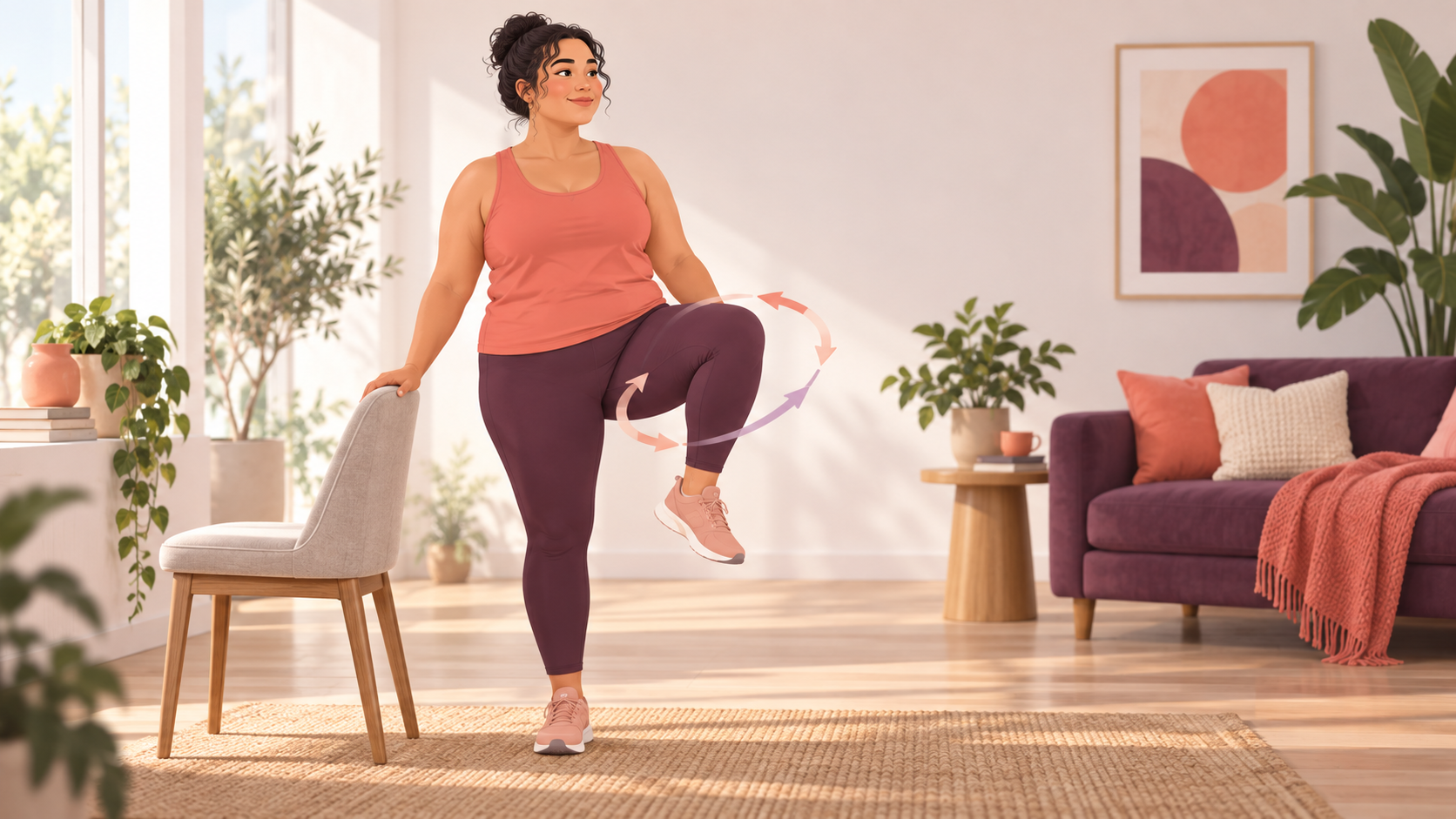
Stand beside a sturdy chair, lightly hold it, and trace one slow knee circle without letting your pelvis follow. Lift the knee, open it to the side, rotate the thigh so the knee turns down, sweep the leg behind you, and return. Reverse the exact path.
Follow these steps:
Walk or march easily for one to two minutes.
Stand tall beside a stable chair, counter, or wall.
Keep a soft bend in the standing knee.
Gently brace your trunk and point both front hip bones ahead.
Lift one knee until just before your back rounds or pelvis tucks.
Move the knee out to the side without leaning away.
Rotate the thigh so the knee gradually points toward the floor.
Sweep the thigh behind you without arching your lower back.
Return the foot to the floor, then reverse the circle.
Move slowly enough to notice the difficult corner. If you have to swing through it, shrink the circle. For a simpler starting sequence, try hip mobility exercises for beginners before returning to the full rotation.
What should move during a hip CAR?
The thigh should move inside the hip socket while your trunk, pelvis, standing leg, and shoulders stay as quiet as practical. Perfect isolation is not required. The useful target is less compensation, a smooth breath, and a circle you can reverse under control.
Use this form table while you practice:
| Part of the circle | Useful cue | Common compensation | Quick fix |
| --- | --- | --- | --- |
| Knee lifts forward | “Stay tall” | Lower back rounds | Lift the knee less |
| Knee opens sideways | “Belt buckle forward” | Pelvis rotates open | Make the side arc smaller |
| Knee turns down | “Move slowly through the corner” | Knee drops suddenly | Pause, then use less range |
| Thigh moves behind | “Ribs over pelvis” | Lower back arches | Shorten the backward sweep |
| Circle reverses | “Retrace the path” | Leg swings quickly | Use the chair and slow down |
Yes. Ordinary hip circles usually let the pelvis and torso travel with the movement, making them accessible as a general warm-up. Hip CARs deliberately reduce that extra movement, use a slower tempo, and ask you to control every part of the circle in both directions.
| Choose this | When it fits | What to focus on |
| --- | --- | --- |
| Easy standing hip circles | You want a quick, low-effort movement break | Rhythm, comfort, relaxed breathing |
| Supported hip CARs | You want to practice control through the hip's range | Slow tempo, quiet pelvis, small circle |
| Seated hip rotations | Standing balance is distracting | Smooth inward and outward rotation |
| Gentle hip stretches | A specific area feels stiff after sitting | Calm holds without forcing |
Neither version is universally “better.” Use ordinary circles when ease and movement are the job. Use CARs when attention and control are the job. The four-minute hip circle warm-up gives you a relaxed version to use before walking, running, cycling, or lifting.
What is an easy 5-minute hip CAR routine?
Warm up for one minute, practice two supported circles in each direction per hip, then finish with an easy walk. Keep each circle small enough to take 10 to 20 seconds without holding your breath. This short dose is easier to repeat than a high-repetition mobility session.
Try this sequence:
1 minute: easy walking or marching.
1 minute: seated knee-in and knee-out hip rotations.
1 minute: two supported hip CARs each way on the right.
1 minute: two supported hip CARs each way on the left.
1 minute: easy walking, then notice whether the hips feel smoother—not necessarily looser.
Do not chase fatigue. Quality usually falls when you add repetitions. Save the sequence in Wiggle with a slow timer so the pace is decided before you begin. If you would rather follow a mixed routine, use the hip mobility stretches guide.
Why does a hip CAR feel pinchy or uneven?
A hip CAR can feel uneven because people naturally have side-to-side differences and because control changes across the circle. Pinching, catching, or pain is not a cue to push harder. Reduce the range, slow down, try an easier rotation, or stop the drill.
Use this decision checklist:
If the pelvis turns, make the circle smaller.
If balance is the problem, use firmer chair support.
If the movement is jerky, pause before the difficult corner.
If you hold your breath, reduce effort and range.
If you feel a mild stretch, stay calm and controlled.
If you feel sharp pain, pinching, catching, numbness, tingling, weakness, or radiating symptoms, stop.
New, severe, persistent, injury-related, or medically concerning symptoms deserve advice from a qualified health professional. A general mobility drill should not be used to diagnose or treat a hip problem.
How often should you practice hip CARs?
For a gentle mobility habit, practice two or three controlled circles in each direction per side a few times per week, or use a smaller range during regular movement breaks. The best frequency is one that preserves smooth form and does not aggravate symptoms.
The U.S. physical activity guidelines emphasize moving more and sitting less; hip CARs can be one small part of that bigger pattern. They do not replace walking, strength work, or personalized clinical care. Pair them with a routine you can actually repeat, then adjust based on comfort.
Sources
Why we keep it gentle
These guides are written for everyday stiffness and habit-building. They are grounded in mainstream guidance on flexibility, movement, and when to seek medical help.
Hip CARs are controlled articular rotations: slow, deliberate circles that move one hip through a comfortable range while the pelvis and trunk stay as still as possible. They are a mobility drill, not a stretch you force. Use a chair for support, keep the circle small, and prioritize smooth control over height.
How many hip CARs should I do?
Start with two or three slow circles in each direction per side. One controlled circle can take 10 to 20 seconds. More repetitions are not automatically better; stop the set when the movement becomes jerky, the pelvis twists, or you have to hold your breath.
Should hip CARs hurt?
No. Hip CARs may feel effortful and may reveal a stiff part of the circle, but they should not cause sharp pain, pinching, catching, numbness, tingling, weakness, or radiating symptoms. Make the circle smaller or stop. Seek qualified care for new, severe, persistent, injury-related, or concerning symptoms.
Are hip CARs the same as hip circles?
They are related but not identical. Casual hip circles often let the pelvis and torso move freely. Hip CARs deliberately limit movement elsewhere so the working hip traces a slow, controlled circle. A standing hip circle is easier; a strict hip CAR demands more control.
When is the best time to do hip CARs?
Do gentle hip CARs after a minute or two of easy walking, during a movement break, or near the start of a warm-up. Keep the range smaller before activity. If you use them as a mobility practice, two or three calm circles per side are enough to learn from without turning the drill into a workout.