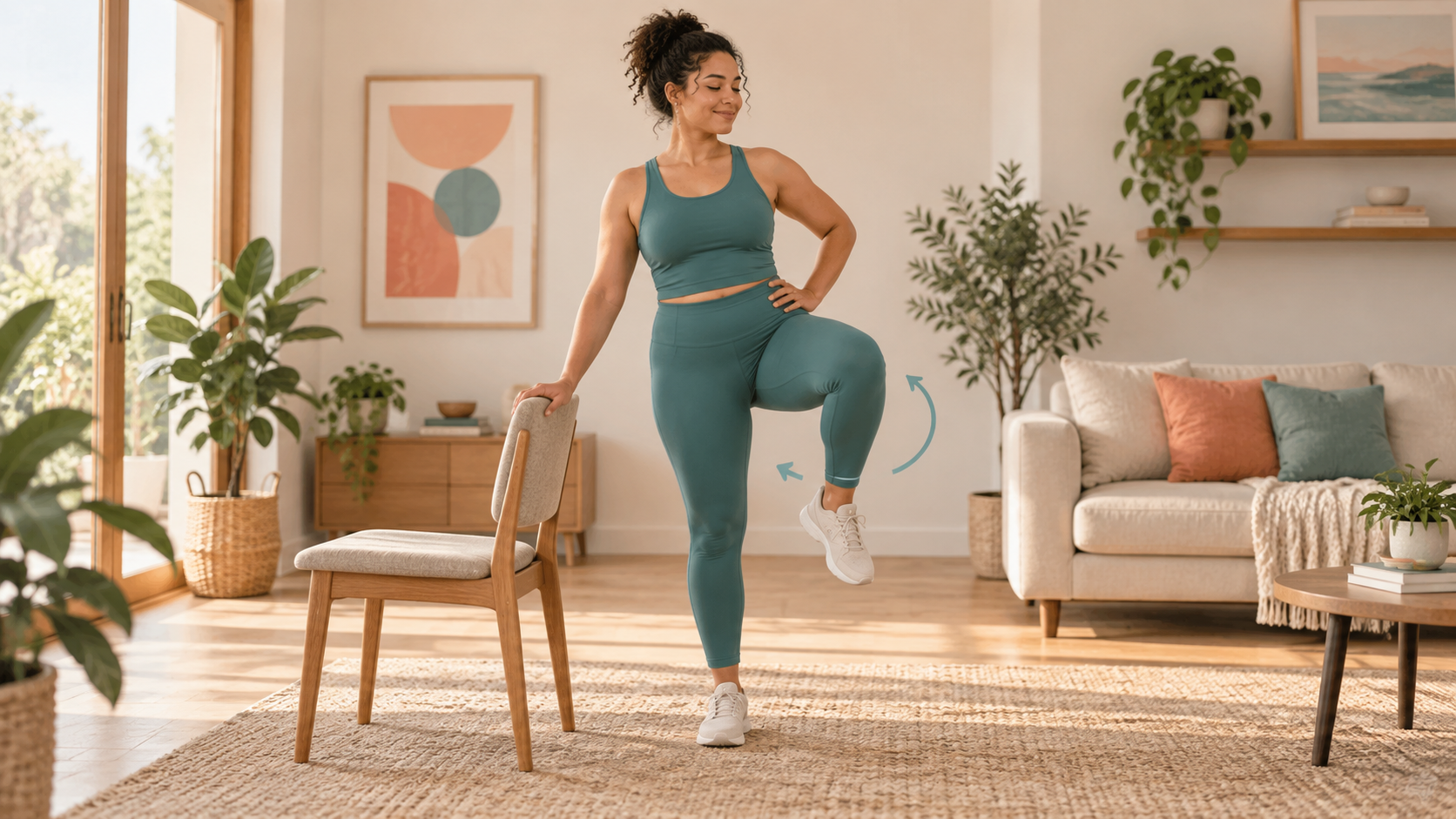
Try a gentle hip circle warm-up with supported and standing options, form fixes, activity-specific choices, and clear stop signs.
hip circle warm up
Cold, stiff hips can make the first squat, stride, or stair feel awkward. The usual mistake is responding with the biggest circle possible. That turns a warm-up into a balance challenge and often makes the pelvis do more work than the hip.
Use this fast rule: walk first, circle small, then rehearse your activity. Spend one minute getting warm, do five comfortable circles each way per side, and finish with two movements that resemble what comes next. The whole sequence takes about four minutes.
Are hip circles a good warm-up?
Hip circles can be a useful warm-up movement because they take the hip through several directions without requiring a long hold. They work best after easy walking or marching and before more activity-specific movements. Keep them smooth and comfortable; the goal is readiness, not maximum range.
A hip circle warm-up is a short sequence of relaxed, controlled circles used to prepare the hips and surrounding muscles for movement. It is not a flexibility test and should not cause pain.
The American Heart Association recommends warming up by doing the planned activity at a slower pace for several minutes. Hip circles can fit inside that gradual transition, but they should not be the entire warm-up. If you are unsure how your hips move in different directions, start with the gentle hip mobility test on a separate day.
How do you do a standing hip circle?
Stand beside a chair, lift one knee only a little, and draw a small circle with it while breathing normally. Complete five smooth circles, reverse direction, and switch sides. Let the pelvis move naturally, but avoid swinging, leaning far away, or chasing a bigger circle.
Walk or march for one to two minutes.
Place one hand on a sturdy chair, counter, or wall.
Soften the standing knee and keep your ribs comfortably stacked over your pelvis.
Lift the other knee a few inches.
Guide the knee forward, outward, down, and back in a small circle.
Repeat five times, then reverse for five circles.
Switch legs and use the same easy range.
If standing balance distracts you, sit near the front of a stable chair and move one knee inward and outward instead. For a slower drill that minimizes movement from the pelvis, progress to hip CARs; they are related, but they serve a different purpose.
How large should a hip circle be?
Make the circle only as large as you can keep it smooth, comfortable, and easy to reverse. A useful warm-up circle may be surprisingly small. Reduce the range when your torso leans, your standing foot grips the floor, or the lifted leg starts to swing.
| What you notice | What it usually means for the drill | Quick adjustment |
| --- | --- | --- |
| You wobble or grab for support | Balance is limiting the movement | Hold the chair more firmly and shrink the circle |
| Your torso leans far sideways | The circle is too large | Lift the knee less |
| Your lower back arches | You are forcing the backward part | Shorten the sweep behind you |
| The movement clicks without pain | The range may still be comfortable | Try a smaller circle and monitor it |
| You feel pinching or sharp pain | The drill is not comfortable | Stop rather than pushing through |
Mayo Clinic advises warming up before stretching, moving smoothly, and avoiding pain. Those principles apply here too: do not bounce into a difficult corner or force both hips to make identical circles.
What is a simple four-minute hip circle warm-up?
Walk for one minute, use one minute for supported circles on each side, and spend the last minute rehearsing your next activity at low intensity. This order raises the effort gradually and keeps the hip circles from becoming an isolated mobility ritual.
Minute 1: Easy walking or marching.
Minute 2: Five supported circles each way on the right, then shake the leg out.
Minute 3: Five supported circles each way on the left, then walk a few steps.
Minute 4: Choose two activity-specific movements and alternate them slowly.
Use Wiggle to set the four one-minute blocks before you start. A timer removes the temptation to keep repeating the stiff side and gives the warm-up a clear finish.
What should you do after hip circles?
Follow hip circles with movements that resemble the activity ahead. Walkers can use easy step-throughs, runners can add marching and gentle leg swings, and lifters can practice shallow bodyweight squats. Start slowly, then increase range or pace only when the movement feels settled.
| Your next activity | Add after hip circles | Keep it easy by |
| --- | --- | --- |
| Walking or hiking | Step-throughs and low step-ups | Using a short stride first |
| Running | Marching and gentle front-to-back leg swings | Keeping the swings below maximum height |
| Squatting | Shallow bodyweight squats | Stopping before depth changes your form |
| Cycling | Easy pedaling | Starting with low resistance |
| General movement break | Side steps and relaxed walking | Staying conversational, not breathless |
No. A warm-up hip circle is rhythmic and relaxed, and it allows some natural movement through the pelvis. A hip CAR is slower and more deliberate: you try to keep the pelvis and trunk still while the thigh traces each part of the circle under control.
Choose ordinary circles when you need a quick transition from rest to activity. Choose supported hip CARs when you want to practice control and notice where the circle becomes difficult. Neither should be forced, and neither is a treatment for hip pain.
When should you stop doing hip circles?
Stop if hip circles cause sharp or worsening pain, pinching, catching, locking, numbness, tingling, weakness, or symptoms traveling down the leg. Make the range smaller when the movement merely feels awkward. Seek qualified care for new, severe, persistent, injury-related, or medically concerning symptoms.
Warm-ups should leave you feeling more prepared. They should not create fatigue, require you to hold your breath, or make symptoms escalate. If you have a recent injury, operation, joint replacement, or condition that affects balance, follow guidance from your clinician or physical therapist.
How often can you use this warm-up?
Use the routine before activities that feel better with a gradual start, or as a brief movement break after sitting. One controlled round is enough for many people. The useful dose is the smallest one that helps you move into the next activity comfortably.
MedlinePlus frames physical fitness as a mix of activities rather than one drill. Treat hip circles the same way: they are an easy opening move, while regular walking, appropriate strength work, and varied movement do the larger job.
Sources
Why we keep it gentle
These guides are written for everyday stiffness and habit-building. They are grounded in mainstream guidance on flexibility, movement, and when to seek medical help.
Hip circles can be a useful part of a warm-up because they gently move the hips through several directions. Start after one or two minutes of easy walking, use small smooth circles, and follow them with movements that match your activity. A warm-up should make you feel ready, not tired or sore.
How many hip circles should I do?
Start with five slow circles in each direction, then switch sides. One round is often enough for a short warm-up. Add a second round only if the movement stays smooth and comfortable; more repetitions are not helpful when your pelvis twists, your balance fades, or the circle becomes rushed.
Should I do hip circles before or after exercise?
Use small, flowing hip circles before exercise as part of a dynamic warm-up. After exercise, choose slower circles or comfortable stretches if they feel good. Before activity, avoid forcing the largest possible range or holding an intense end position.
What is the difference between hip circles and hip CARs?
A warm-up hip circle is relaxed and rhythmic, and the pelvis may move a little. A hip CAR is much slower and asks you to keep the pelvis and trunk quiet while the thigh traces a controlled circle. Use hip circles to get moving; use hip CARs to practice control.
Why do hip circles feel pinchy?
A pinch can appear when the circle is too large, the knee is lifted too high, or that direction does not feel comfortable for you. Shrink the circle or stop. Do not push through sharp pain, catching, numbness, tingling, weakness, or symptoms that travel down the leg.